BibleProject
- 4.7
- Rating
- 1.00M
- Installs
- Free
- Price

 Analysis by App-foxy
I approached BibleProject less like a digital Bible and more like a guided learning tool. That distinction matters. Its central value is helping me understand how individual books fit into the larger biblical story, rather than simply giving me another place to read familiar passages. After spending time with it, I found the experience most useful when I wanted context, structure, and a clearer sense of how themes develop across a book.
It is a free education app from BibleProject, available for Everyone and compatible with devices running OS 10 or later. The app has built a strong audience, with more than 500 thousand installs and an average rating of 4.8 from roughly 4.8 thousand ratings. Those figures do not replace personal experience, but they do match my impression that this is a focused, approachable resource rather than a poorly maintained companion app.
Seeing the Bible as a connected story
The capability that stands out most is the way BibleProject helps me see meaning and structure across the books of the Bible. Instead of treating each chapter as an isolated block of text, it encourages me to look for the main ideas, movements, and connections that give a book its shape. That changes how I read. I am less likely to get stuck on a difficult paragraph without knowing where it belongs in the wider argument.
You May Also Like

 Blood Strike: 2.5 Anniversary
Blood Strike’s Loadouts Turn Every Drop Into a Tactical Gamble
A close look at Blood Strike’s custom loadouts: how fast access to signature weapons reshapes its battle royale rhythm, rewards preparation, and narrows the gap between fights.

 Pandora - Music & Podcasts
Pandora’s Music Is Easy to Start, but Harder to Recover
Pandora’s strength is its low-effort path from a seed to a station. Its weak spot is how much confidence it asks you to place in connection, setup, and quiet recovery.

 8 Ball Pool
 Is Built on Rivalries, Rematches, and Routine
A close look at the rivalries, rematches, shared routines, and unanswered safety questions that turn a quick pool match into a persistent mobile community.

 Samsung Music
’s Quiet Strength Is Playing What You Already Own
Its reach comes less from spectacle than from dependable access to a personal library. That simplicity is both the app’s strongest retention engine and its ceiling.

 AccuWeather: Weather Radar
AccuWeather Review: A Quick, Clear Forecast for Everyday Decisions
For everyday plans, the best forecast is the one you can understand quickly. AccuWeather makes rain timing, radar, and local conditions easy to act on, with a few trade-offs.

 Hill Climb Racing
Why Hill Climb Racing Still Turns Crashes Into One More Run
A tiny car, a bumpy hill and one more upgrade: Hill Climb Racing keeps resurfacing because its simple chaos makes every near-miss feel personal.
More From Our News Desk



For me, the most useful effect is orientation. When I open a book I have not read recently, I can first build a mental map before trying to interpret every detail. I can ask what kind of writing I am reading, what problem or question seems to drive it, and how its major sections relate to one another. That preparation makes a longer reading session feel less scattered.
This is especially helpful for readers who know individual stories but struggle to connect them. A familiar passage can feel very different when I understand what comes before it and what follows. BibleProject’s educational approach gives me a reason to pause before rushing into isolated quotations. The app’s real strength is not replacing reading; it is making reading more coherent.
I also appreciated that the experience feels suitable for several levels of familiarity. Someone new to the Bible can use it as a gentle starting point, while a more experienced reader can use it to refresh the overall structure of a book. It does not require me to begin with a complicated study method, and I can return to the same material when a later reading raises a new question.
Why context changes the reading experience
Many Bible apps concentrate on search, daily verses, reading plans, or multiple translations. Those tools are useful, but they often assume that I already know how to approach the passage. BibleProject takes a different route by emphasizing understanding before speed. I found that valuable when a book felt unfamiliar or when I had been reading in short, disconnected bursts.
A practical example is a busy weekday morning. I might have only a few minutes and feel tempted to open a random verse because it is easy. With this app, I can instead spend that short session getting a clear overview of a book or theme. Even without completing a long study, I leave with a better idea of what to notice when I return to the text later.
That workflow is more useful than it may sound. A quick orientation can prevent a common mistake: interpreting a sentence entirely on its own. I still need to read carefully, and the app does not remove the need for judgment, but it gives me a framework for asking better questions. I found myself paying more attention to repeated ideas and transitions instead of treating every line as an independent lesson.
How I used it in practice
I would begin with one book rather than jumping between unrelated subjects. First, I looked for the broad shape of the material. Then I read the relevant passages with that shape in mind. Finally, I returned to the overview to check whether my first impression still made sense. This three-step loop worked better for me than consuming explanations without opening the text itself.
Another useful habit is to use the app before a group discussion. If everyone arrives with a different level of familiarity, a shared overview can make the conversation more productive. I can bring a basic understanding of the book’s direction without pretending that I have mastered every interpretation. The app works best here as preparation, not as a substitute for listening to other people or examining the passage closely.
For personal study, I would keep a simple notebook beside the phone. I noted one central question, one repeated idea, and one section I wanted to revisit. This prevented the experience from becoming passive. The educational material gave me a starting point, while writing down my own observations made the session feel like study rather than casual scrolling.
That approach also reveals an important limitation. BibleProject can help organize my attention, but it cannot do the entire work of interpretation for me. If I want detailed analysis of language, historical debates, manuscript questions, or competing scholarly positions, I would need a more specialized resource. This app is strongest at building understanding and momentum, not at serving as a complete academic reference.
A realistic everyday use case
Imagine that I am preparing for a weekly discussion after several days of inconsistent reading. I do not have enough time to start from the beginning and work slowly through every section. I can use BibleProject to regain the outline first, identify the part under discussion, and then read that passage with a clearer sense of its place in the book. That is a realistic advantage: it helps me recover context when my attention has been fragmented.
The same method works for a parent or teacher introducing a book to someone else. Rather than handing over a dense block of text and hoping it becomes approachable, I can use the app to establish the big picture, then invite the learner to notice details. For younger users, the Everyone content rating makes the app feel broadly accessible, although the depth of the subject still means that explanations may need to be adapted to the person’s age and background.
I also see value for someone returning to faith after a long break. The app does not force a demanding schedule, and its educational focus can make the first steps less intimidating. Instead of asking, “Where do I even begin?” I can choose a book, learn how it is organized, and read a manageable portion with some direction.
What the app does better than common alternatives
Compared with a standard Bible reader, BibleProject gives me more help before I begin reading. A conventional reader is usually better when I already know the passage I want, need a fast search, or want to compare translations. BibleProject is better when my problem is not access to the words but understanding how those words work together.
Compared with a daily devotional, it feels less dependent on a single short reflection. Devotionals can be encouraging and convenient, but they may encourage me to consume one thought at a time. BibleProject pushed me toward broader patterns. I found that difference important because it helped me read books as complete works rather than collecting disconnected inspirational moments.
Compared with a full study platform, it is easier to approach but less suited to exhaustive research. A specialist tool may offer more reference material, detailed notes, and technical options. I would choose that kind of product when preparing a serious lesson or investigating a difficult historical question. I would choose BibleProject when I need a clear starting point or want to rebuild my overall understanding without feeling buried in information.
The trade-off is therefore quite clear. Simplicity makes the app welcoming, but it also means that users seeking a large research library may outgrow it. I do not consider that a flaw in itself. It becomes a problem only if I expect one app to function simultaneously as an introduction, a devotional guide, a reference work, and a scholarly database.
Where the experience can feel limited
The educational approach may not satisfy someone who wants immediate, verse-by-verse answers. If I open an app with a precise question and expect a quick technical explanation, the broader orientation can feel indirect. BibleProject asks me to understand the surrounding story, which is valuable, but not always the fastest route to a narrow answer.
There is also a risk of passive learning. Clear explanations can create the impression that I understand a book simply because the overview made sense. I had to make an effort to return to the text and test my understanding. My best results came when I treated the app as a map, not as the destination.
Another trade-off is that a big-picture approach can smooth over the difficulty of individual passages. A helpful overview may show the direction of a book, but it cannot make every tension disappear. Readers should be prepared to encounter questions that remain open after using the app. In my view, that is healthy, provided the app is used to begin deeper reflection rather than end it.
People who prefer a quiet, text-only reading environment may also find the educational presentation more involved than necessary. If my only goal is to read a chapter quickly, a basic reader is likely more efficient. BibleProject earns its place when I want guidance and context, not when I want the fewest possible steps between opening the app and reaching a verse.
Who benefits most from this approach
I would recommend it first to beginners who feel overwhelmed by the size and variety of the Bible. It gives them a way to approach a book with some direction instead of choosing randomly and hoping the material becomes clear. It is also a good fit for readers who have accumulated fragments of knowledge but lack a connected picture.
Students, small-group participants, and teachers can benefit from using it before discussion or lesson preparation. The app can help identify the main shape of a book, which makes later questions more focused. I would still pair it with the primary text and, when needed, additional commentary. That combination balances accessibility with depth.
It is also useful for experienced readers who want a reset. I sometimes understand a passage differently after stepping away from familiar assumptions. Revisiting the overall structure can reveal connections I missed when I focused too closely on individual verses. The app’s value in that situation is not novelty for its own sake; it is the chance to re-enter a book with a more organized perspective.
I would be less likely to recommend it as the only tool for academic study, detailed sermon research, or translation comparison. Someone with those needs should look for a resource designed around technical references and close analysis. BibleProject can still serve as an introductory layer, but it should not be expected to carry the whole workload.
Practical advice before making it part of a routine
Start with a single book and give yourself a clear purpose. Do not try to absorb everything in one sitting. I found it more effective to use the app for orientation, read a section in the Bible, and then return with one or two specific observations. This keeps the experience active and makes it easier to notice whether the material is genuinely improving my understanding.
If you are studying with other people, agree on the passage before opening the app. That way, the overview supports the conversation instead of replacing it. Ask each person to bring one question that the overview helped clarify and one question that still needs discussion. This simple distinction prevents the group from confusing a useful summary with a final interpretation.
On a phone, I would also avoid treating the app as background entertainment. Its educational value depends on attention. A short, focused session is more useful than leaving it open while multitasking. I found that even a few deliberate minutes could improve a later reading, while a distracted session left little behind.
The current version is 2.24.1, and the app remains free to use. That removes a major barrier for people who want to explore it without committing to a subscription or purchase. Its release on December 30, 2021, also places it among relatively established learning apps rather than a brand-new experiment. BibleProject has developed the app for a broad audience, and the combination of a free price and Everyone rating makes it easy to suggest to a friend or family member.
My final assessment
BibleProject works because it addresses a problem that ordinary reading apps often leave untouched: knowing how to see the whole before getting lost in the parts. I found its strongest contribution in the way it prepares me to read with direction. It helped me slow down, recognize structure, and approach difficult material with better questions.
It is not the right choice when I need a bare-bones reader, advanced research tools, or instant answers to highly specific technical questions. In those situations, a conventional Bible app or a specialized study platform would serve me better. But for learning the shape and meaning of biblical books, especially when I feel uncertain about where to begin, it offers a thoughtful and approachable path.
If you want context before commentary and understanding before speed, BibleProject is worth trying. I would use it alongside the Bible itself, keep short notes, and return to the passages rather than stopping at the overview. Used that way, it becomes more than an attractive educational app: it becomes a practical bridge between opening a book and genuinely knowing how to read it.
FAQs for BibleProject
01What is BibleProject and what features does it offer?
BibleProject is an app designed to help users understand the Bible through animated videos, podcasts, and study guides. It offers a comprehensive library of content that explores themes, books, and characters of the Bible. Features include easy navigation, offline access, and a community forum for discussions. It’s ideal for both beginners and seasoned readers.
02Is BibleProject free to use, or does it require a subscription?
BibleProject is free to download and use, providing access to a wide range of videos and resources without any subscription fee. However, users have the option to support the project through donations. There are no hidden costs, making it accessible for everyone interested in exploring biblical themes at no charge.
03Can I access BibleProject content offline?
Yes, BibleProject allows users to download videos and resources for offline access. This feature is particularly useful for those who wish to study the Bible without the need for a constant internet connection, making it convenient for use during travel or in areas with limited connectivity.
04How user-friendly is the interface of the BibleProject app?
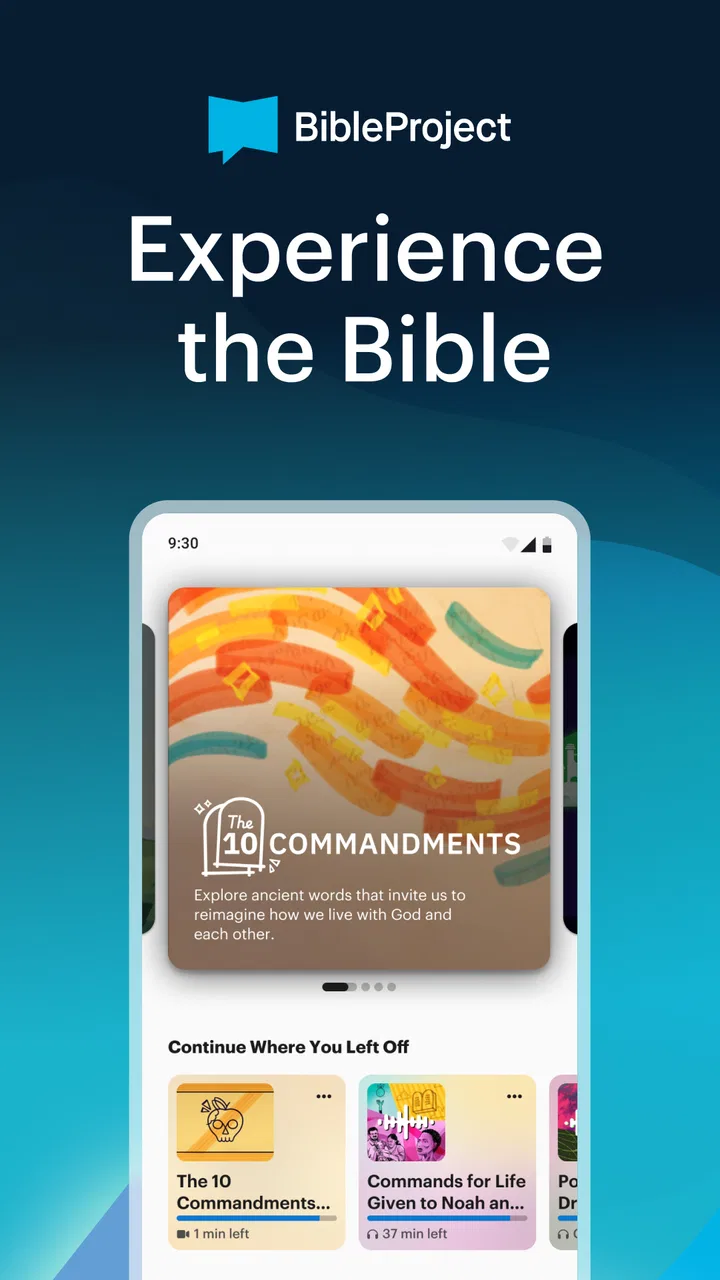
The BibleProject app is designed with a user-friendly interface that is easy to navigate. Whether you’re searching for specific themes or exploring new content, the app provides intuitive menus and search functions. The visual layout is clean and organized, ensuring a pleasant and straightforward user experience.
05Is BibleProject suitable for all age groups?
BibleProject content is crafted to be accessible for a wide range of age groups, including teens and adults. The animations and language used are engaging yet respectful, making it a suitable educational tool for families and study groups. However, younger children might need guidance to fully grasp some of the concepts presented.
Pros
- Engaging and visually rich animations.
- Comprehensive biblical insights.
- User-friendly interface.
- Regularly updated content.
- Multilingual support available.
Cons
- Requires internet for video streaming.
- Limited interaction features.
- No offline mode for videos.
- Focused mainly on Christian teachings.
- Content may be too detailed for beginners.

BibleProject
Gallery